
QUESTIONABLE
Summary (Updated 1/19/26): Asheville staff are proposing to move forward with a more modest multifamily housing construction program ($11 million instead of $28 million) and holding back on the commitment of an additional $17 million in housing recovery money. They are evaluating how to balance the need for multifamily housing and single-family home repair with those remaining funds. Staff will be presenting their latest plans at the Housing and Community Development Committee meeting on 1/20/26 at 10 am. You can access the materials and a livestream (later a video recording) for that meeting here.
Original Summary (12/8/2025): Asheville staff are recommending a $17 million cut for multifamily affordable housing in order to finance more single-family home repair and reconstruction.
Access a one-page summary of the original report on this issue here and a slideshow here.
Update (12/15/2025): Our advocacy has had some influence. The City has extended its timeline for considering this change in order to get more input. Check out our updated “Things to do” section below for ways to take action.
Update (12/22/2025): Due in part to our collective action, Asheville is now exploring a range of options for addressing our community’s affordable housing needs. Updates are expected in January, and we’ll keep tracking this issue closely.
The Facts: On Tuesday, December 16th, the Asheville Housing and Community Development Committee received a report on proposed changes to the Community Development Block Grant Disaster Recovery (CDBG-DR) action plan. Asheville’s Community Development Division Manager made a similar presentation to the Housing Recovery Board on December 3rd (see the links below).
The CDBG-DR action plan, approved by the United States Department of Housing and Urban Development (HUD) last spring, included a total of $225 million in funding for a range of projects, including $31 million for housing.
- In the original plan, $28 million was earmarked for multifamily affordable housing, with an emphasis on deeply affordable housing.
- Also in the original plan, $3 million was earmarked for single family repair and reconstruction of homes damaged by the storm. This repair and reconstruction process will be administered through a state-run program called Renew NC.
- In the proposed amended plan, the City would cut multifamily funding from $28 million to $11 million, and increase single family home repair and reconstruction (through Renew NC) from $3 million to $20 million.
- City staff claim this change is needed because there is more demand for single-family focused aid than they anticipated.
- Renew NC has set up a tiered system.
- In “Phase 1,” the highest priority will be given to families who make less than 60% of Area Median Income (AMI), which translates to $57,000 for a family of four. They are also giving priority to families with seniors over 62, children under the age of 18, and individuals with disabilities.
- Once all Phase 1 applications have been processed, the program will move on to fund other families. In Phase 2, those making between 60% and 80% AMI ($75,000 for a family of four) will be considered. In later phases, homeowners with incomes up to 120% AMI ($118,000 for a family of four) will be eligible.
- The Renew NC program operates within these parameters:
- Any home damaged by Helene is eligible for repairs if the cost is $50,000 or less.
Homes with damage of more than $50,000 are eligible to be reconstructed, up to a total cost of $450,000 per home. - The program will only supplement, and cannot replace, prior repair or reconstruction payments from other programs.
- Financing temporary housing while a home is being repaired or rebuilt is the responsibility of the homeowner.
- Any home damaged by Helene is eligible for repairs if the cost is $50,000 or less.
City staff suggest that there are other programs that can be used to finance additional multifamily affordable housing construction, such as WNC Affordable Housing Loan Fund and HOME-ARP resources, to offset the proposed $17 million cut of CDBG-DR funding for this purpose.
You can see the slides presented at the Housing Recovery Board here, and watch the video of the presentation here. The slides presented at the Housing and Community Development Committee on 12/16/25 are here, and the video is here.
Our Assessment: We have several significant concerns about this plan.
Concern: Multifamily affordable housing construction is a high priority need and should not be cut.
- It’s common knowledge that our region is in the midst of a major affordable housing crisis, one that predated Hurricane Helene but which was greatly exacerbated by the storm. The 2023 National Community Survey found that affordable housing was the top unmet need in our city.
- When the City of Asheville surveyed residents earlier this year, affordable housing was named as one of the highest priorities for our region. 45% of those surveyed considered it “essential,” which ranked fourth overall. (“Improving water infrastructure to make it stronger and more reliable” ranked first, with 78% considering it “essential.”)
- The CDBG-DR funding is supposed to prioritize “low to moderate income” households. When the City’s survey data is disaggregated based on economic data, affordable housing emerges as an even more significant priority for the low income folks it is supposed to serve, with 62% considering it “essential.”
Concern: If more money is needed for single-family repairs and reconstruction, it should come from other programs outlined in the original CDBG-DR action plan
- Our region has many needs, and the existing CDBG-DR action plan is an attempt to address as many as possible. Because resources are limited, hard choices are inevitable. As indicated above, affordable housing is a top priority. We would suggest that some of the other items included in the action plan are comparatively less vital.
- For example, we have serious concerns about the $30 million currently allocated to “revitalizing flooded commercial districts.” We think this is a much more questionable priority, especially when juxtaposed with the need for multifamily affordable housing.
- As outlined in the action plan, this money would be used to rebuild commercial activity in areas close to the French Broad and Swannanoa Rivers that were flooded and destroyed by Helene, such as the River Arts District and Biltmore Village.
- Many experts have cautioned the City to reconsider this approach. For example, the Urban Land Institute was invited by the City to study our situation and make a report. In that report, one of their top recommendations was not to attempt to center Asheville’s arts district in its prior location, but rather to relocate it.
- We think a better way to revitalize the local economy is to ensure that low income workers have housing options that will enable them to stay in the City.
- The City’s survey didn’t ask about “revitalizing flooded commercial districts” specifically, but the questions they asked that touch on it received fewer “essential” ratings than affordable housing.
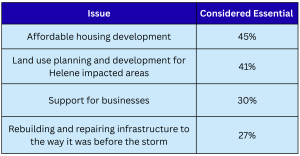
*Chart and all survey data can be found here.
Concern: Investing heavily in Renew NC might not actually support low income homeowners
As described above, the state is running this program, and so far only looking at applications from folks who make 60% AMI ($56,000 for a family of four) or below, with particular emphasis on those families with an elderly person, child(ren), or a disabled person in the household. Enough people who appear to meet that criteria have applied that with the existing funding allocated, most of them won’t get funded. This is the primary rationale for increasing the funding for this program.
However, we’ve heard anecdotally from folks trying to support applicants in other places such as Henderson County about significant limitations to this program. Many lower income people are ultimately dropping out. It’s possible that even though folks making less than 60% AMI will be “first in line,” many of them won’t end up benefitting from the program. Here are two potential reasons for this:
- There is no money for temporary housing while your house is repaired or reconstructed. We suspect that many low income folks who would need to relocate for their repairs/rebuilding will not be able to afford to pay for their own temporary housing.
- Homeowners cannot receive this funding if they have already spent previous grant funding that was supposed to cover repairs. This means that if (for example) your house needs $50,000 in repairs, but you already got a $10,000 grant from FEMA, you have to show that you still have that original grant money or you don’t get the $40,000 from Renew NC. Many low income families may have spent the money from that original grant in order to survive, and don’t have it anymore.
If these (and other) challenges lead to lower income folks “dropping out” of the program once these details are revealed, then the money will go to Phase 2 (60-80% AMI) or Phase 3 and 4 (up to 120% AMI) who are much more likely to be able to kick in their own money to supplement the program money for purposes like temporary housing. So it is plausible that many of the families who end up benefitting from this program could actually be moderate or even above-average income folks.
These questions need answers before the City takes action
This issue won’t go before the full City Council until February, so there is time to engage the City, raise these and other questions, and advocate for a revised amendment to the City’s Recovery Plan. However, we need to start raising these questions now, before the amendment in its current form builds too much momentum.
The Ask: When this proposal went public, we recommended several timely action steps, including emailing the three Asheville City Council members who sit on the Housing and Community Development Committee, watching that meeting, and making a public comment. We are now postponing further action while we engage with the City to better assess their next moves regarding the shortage of affordable housing in Asheville and the use of recovery funding.
REPORT BACK STATUS
Resolved For Now
Report Back
Total GAP Supporter Actions Taken: 38
Recipients and Responses:
Asheville Housing and Community Development Committee Members
- Vice Mayor Antanette Mosley: No response
- City Council Member Sage Turner: No response
- City Council Member Sheneika Smith: No response