
The history of the site Asheville is considering for a performing arts center
Click here to go back to the GAP Report on this issue.
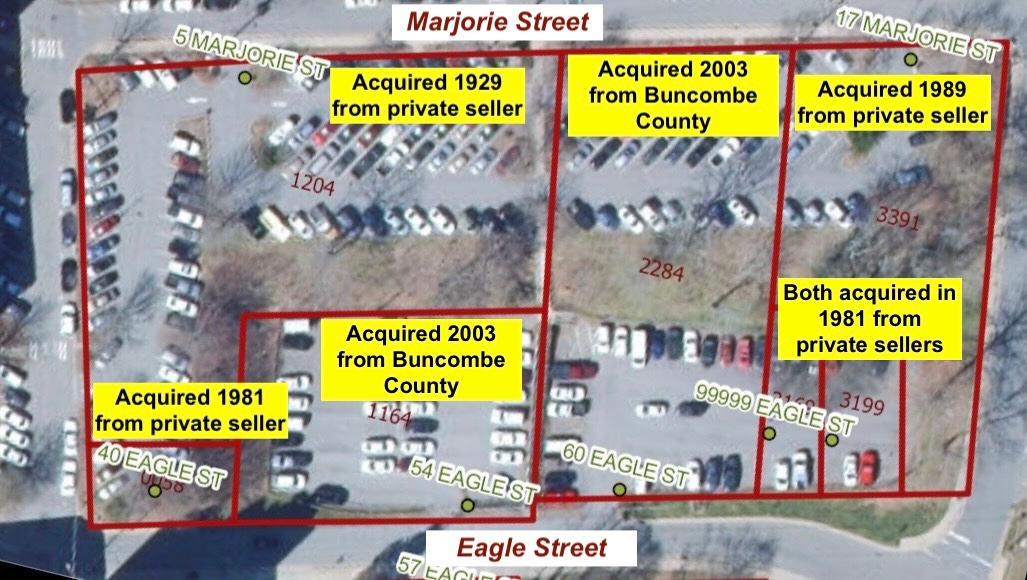
What This Land Looked Like a Hundred Years Ago
Today, the site known as “Parkside” consists of a cluster of parcels between Eagle Street and Marjorie Street, currently used as a municipal parking lot. The City assembled this land over several decades, acquiring parcels at different times from both private sellers and Buncombe County. But this configuration—and this use—is relatively recent.
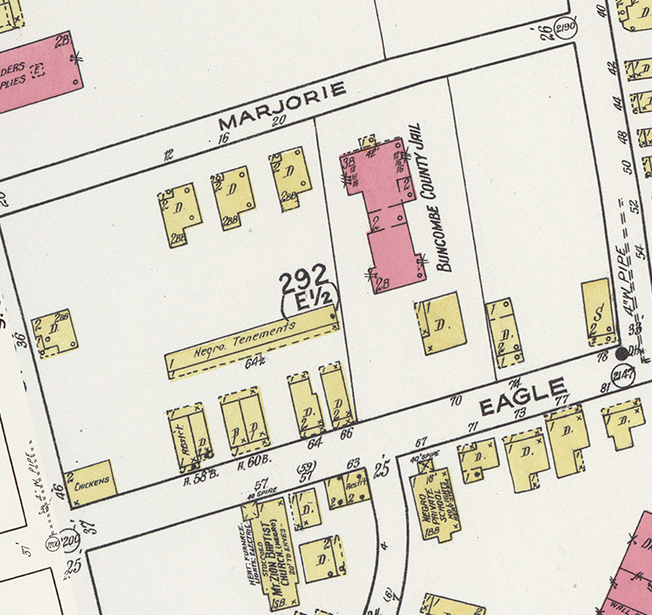
The Jail and the Earliest Institutional Uses
A 1917 Sanborn map of the same block shows a very different landscape. On the Marjorie Street side of the block stood the Buncombe County Jail, a prominent public building that anchored this landscape. Its presence is a reminder that this area was not only residential, but also part of a broader system of law enforcement and incarceration. In the early 20th century, jails like this were part of a wider system in which incarcerated people—disproportionately Black—were put to work in convict labor crews across North Carolina.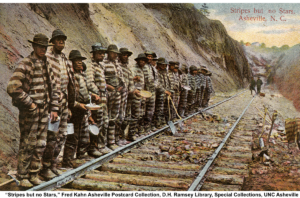
The jail is also where Bob Brackett was held before being lynched in 1897, one of three lynchings in Buncombe County documented by the Equal Justice Initiative (EJI). (There is a commemorative marker for Bracket that EJI put up at Triangle Park just a few blocks from the “Parkside” site.)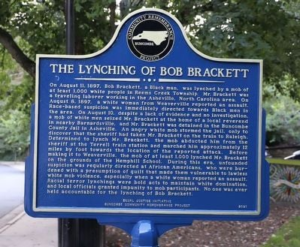
An Active Residential Block on Eagle Street
But while the jail and these systems of control are part of this history, most of the land that makes up the “Parkside” site was, in fact, a residential neighborhood—lined with small homes and tenant buildings, occupied by Black residents connected to the economic and social life of the Block. What appears on the Sanborn map as “Negro Tenements” and a row of modest dwellings was, in reality, a community of families, workers, and neighbors whose lives were rooted in this place.
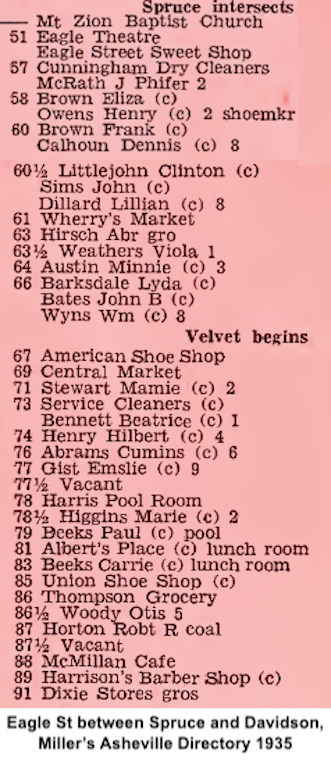 Who Lived Here
City directories from the 1930s offer a snapshot of who lived along this stretch of Eagle Street. Address by address, they list dozens of residents—families, boarders, workers—living in close proximity to what is now a parking lot. Names like Hentz, Abrams, Garner, Freeman, Rice, and Calhoun appear repeatedly, suggesting not just individual households, but an interconnected community. The directories also record how people made a living. Joseph Rice worked as a laborer, likely in one of the many service or industrial jobs that sustained downtown Asheville. George Garner also appears as a laborer. Minnie Austin worked as a maid at the Langren Hotel. William Young, a bill poster at the Eagle Theatre. These entries offer only brief descriptions, but together they point to a working-class Black community whose labor supported the city around them.
What the Records Do — and Don’t — Show
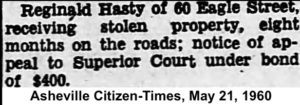
Beyond these brief listings, it becomes difficult to find much about the people who lived here. What survives in the historical record is not a full account of these lives, but a filtered one. When these names do appear in newspapers, it is often in moments of crisis—arrests, court cases, or obituaries. For example, Reginald Hasty, who lived at 60 Eagle Street, appears in local newspapers not as a resident or worker, but in connection with a 1960 arrest and subsequent sentence to road work. These kinds of records tell us something—but they also obscure much of what everyday life on this block actually looked like.
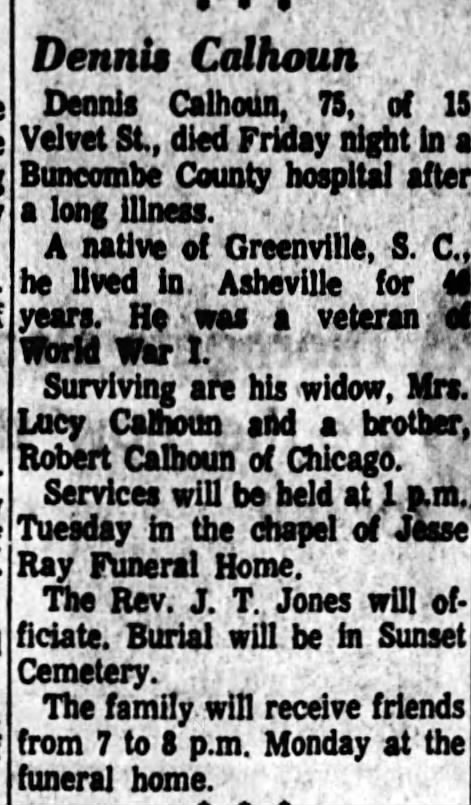
 Occasionally, the record offers a fuller glimpse. An obituary for Dennis Calhoun, who lived in a rear apartment at 60 Eagle for many years, notes his service in World War I, his family, and the community that gathered to remember him. Even these moments are brief—but they are a window into lives that were far richer than the limited records suggest.
 A Surprising Connection: Floyd McKissick
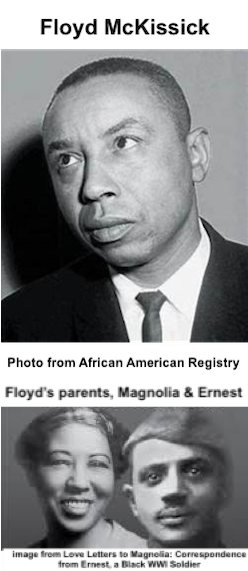 Sometimes the record reveals connections that extend beyond The Block itself. One name connected to this community stands out: Floyd McKissick. After returning from World War II as a decorated veteran, McKissick purchased a building at 40 Eagle Street across the street from the Mount Zion Missionary Baptist Church. He would go on to become a nationally recognized civil rights leader, serving as chairman of the Congress of Racial Equality (CORE) and playing a key role in the Black freedom movement. He later was the champion for the Soul City initiative, an ambitious 1970s project to create a new town in North Carolina that would expand Black economic power, homeownership, and self-governance through planned development. He eventually transferred the 40 Eagle Street property to his parents, Ernest and Magnolia McKissick.
A Community, Not Just a Site
Taken together, these fragments—directory listings, job descriptions, scattered newspaper mentions—begin to sketch a picture of the community that once occupied this block. It was not empty land, nor simply a “site” awaiting development. It was a place where people lived, worked, and built lives, even if the historical record preserves only pieces of those stories. It was a community—a community that existed within living memory, and whose disappearance shaped what this land is today.
By the 1970s, that community was gone.
This story continues in Part 2, where we examine how that happened—how a residential neighborhood became vacant land, and how the City ultimately came to own it.
Click here to go back to the GAP Report on this issue.