
The history of the site Asheville is considering for a performing arts center
Click here to go back to the GAP Report on this issue.
By 2003, the Land Was Assembled
By 2003, the City of Asheville owned all of the land that now makes up the site south of City Hall. With the parcels assembled and cleared, proposals for its future began almost immediately. The timeline shared by the City in February, 2026 captures part of what followed, but a closer look reveals a deeper and more complicated story — one that raises important questions about who has shaped the vision for this land, and who has not.
The Grove Park Inn Proposal
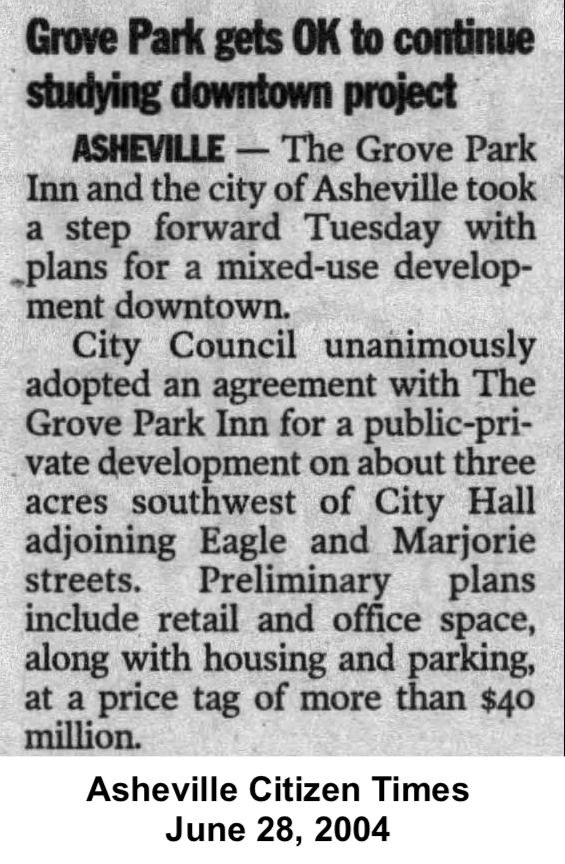 The first major proposal emerged in 2004, when the Grove Park Inn partnered with the City to explore a mixed-use development on the site. The history of the land as homes and community had already been forgotten, and the vision shifted from merely parking to large-scale redevelopment. Preliminary plans included retail, office space, residential units, and structured parking. City Council unanimously approved moving forward with the concept.
Just a year later, however, the Grove Park Inn withdrew. After “extensive research and consulting,” the company concluded the project was not “economically feasible.” The land remained in public hands, and the City once again began searching for a private partner to shape its future.
The Birth of “Parkside”
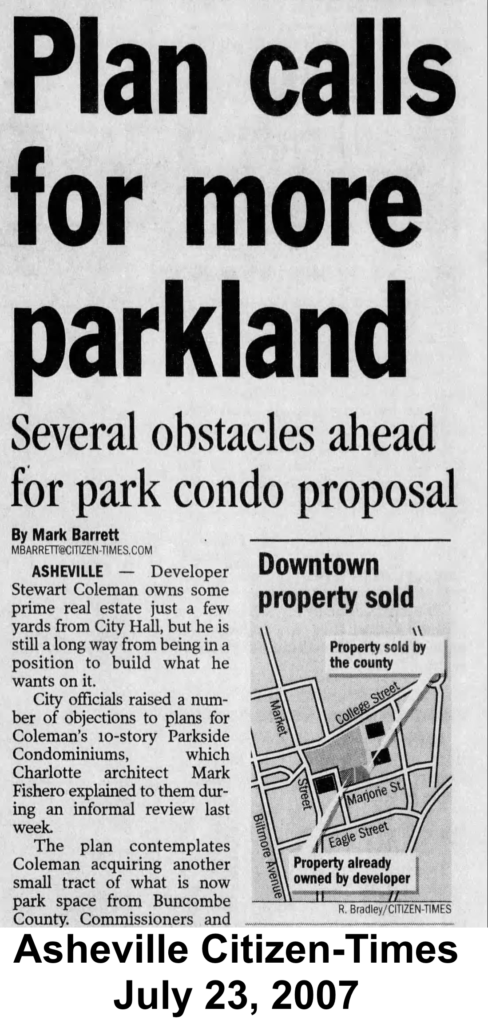 Soon afterward, developer Stewart Coleman proposed building high-end condominiums near Pack Square. He called the project “Parkside.” The proposal proved controversial. Critics raised concerns about the scale of the development, its proximity to City Hall, and the potential loss of a historic magnolia tree. The heirs of George W. Pack, whose gift helped create Pack Square, objected to the plan.
 As negotiations unfolded, one option discussed was a land swap. Coleman could instead build his condominiums on the city-owned land between Marjorie and Eagle Streets — the same site examined in this series. Litigation followed. By 2009, a court ruling favored Coleman, opening the door for development. But by then the project had lost momentum. Coleman ultimately abandoned the condominium proposal and instead opened Pack’s Tavern nearby.
Although the condominium project never moved forward, the “Parkside” name adhered to the City-owned land between Marjorie and Eagle Streets — where it remains today.
The first Performing Arts Center proposal
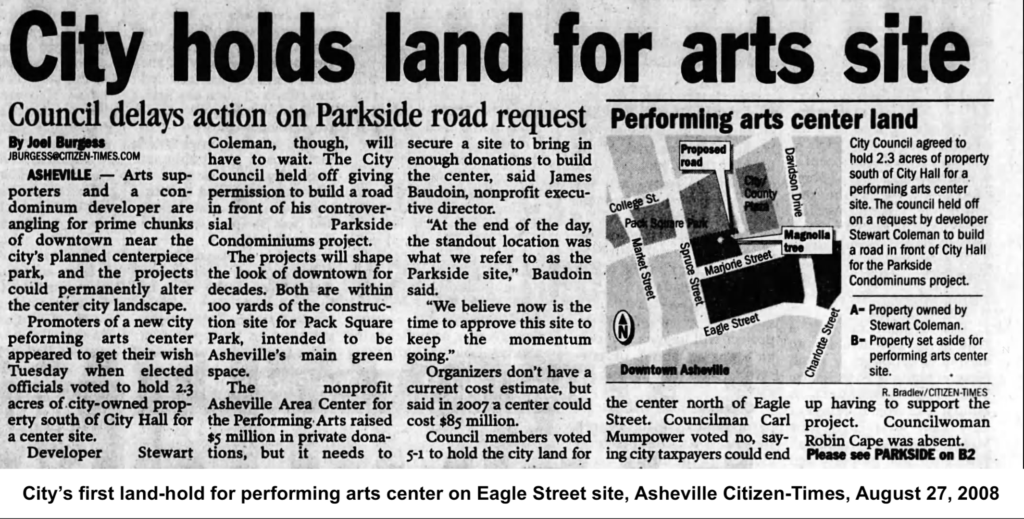
Around the same time, another idea emerged: an earlier iteration of the current performing arts center proposal. In 2008, City Council voted to place a “land hold” on the site to preserve the property while funding and partnerships were explored. This land hold adopted in 2008 mirrors the approach now under consideration — preserving the site while negotiations with private partners move forward.
Over the next several years, the performing arts center appeared sporadically in public discussions, increasingly without a specific site commitment. By 2014, the project was still being discussed, but the momentum had slowed, and no clear path forward emerged.
For nearly a decade, the site faded from public conversation.
A Fire and Police Proposal
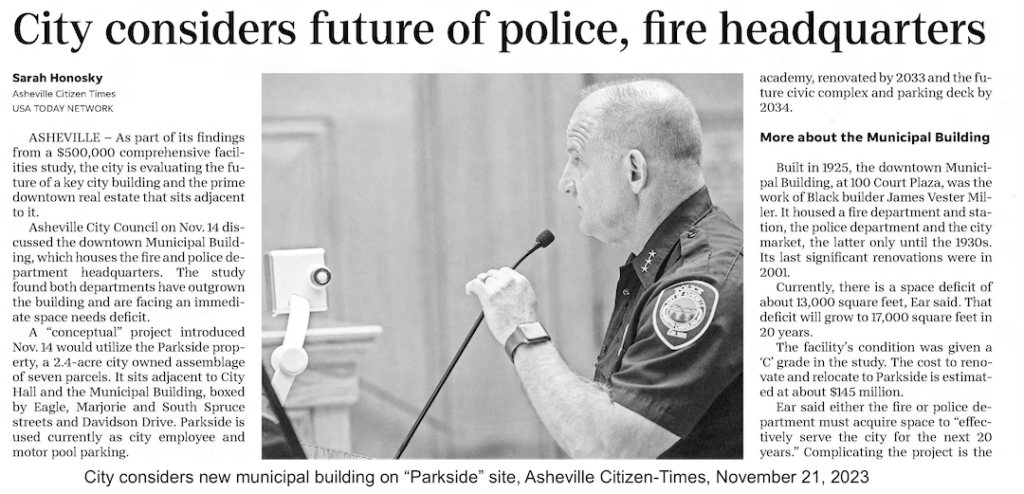
The next time the land resurfaced in public discussion was in 2023, when the City evaluated relocating fire and police headquarters to this location. A proposed conceptual plan also included other civic uses and parking.
Who Was Missing
Across two decades of proposals — mixed-use development, luxury condominiums, a performing arts center, and a civic campus — one pattern is striking: the communities most affected by earlier displacement on this land were largely left out of the conversation.
City Council directed the Grove Park Inn in 2004 to extend “targeted invitations” to organizations such as the YMI Cultural Center and Eagle Market Street Development Corporation as they developed their plan. Nearly twenty years later, during the one public conversation about the fire/police headquarter proposal, one City Council member asked whether the land might instead be considered in the context of repairing harm caused by urban renewal in nearby neighborhoods. The response from the City Manager was succinct: “No.” There was no further discussion.
As for the other two initiatives — the Parkside condominium debate, and the 2008 land hold and subsequent performing arts center discussions — there is no evidence in City Council minutes or newspaper articles that residents of The Block or East End/Valley Street were ever directly engaged. We found no record that City Council or planners ever considered the impact that these plans would have on these communities.
Throughout these decades, decisions were proposed, plans were debated, and partnerships were explored. But the communities whose history is tied to this land were peripheral to those conversations, if not outright ignored.
“Not Urban Renewal”
This time can and should be different. In 2020, the Asheville City Council issued a public apology and intention to make amends for the damage done by urban renewal. They adopted a moratorium on selling or rezoning City-owned land connected to that program. That’s why the planned staff presentation for the City Council meeting on Tuesday, March 24 includes a slide that declared that this site is not “associated with Urban Renewal,” though it sits “adjacent” to “an area impacted by [that program].” If the parcel had been acquired via urban renewal, the land hold could not move forward because of the moratorium.
But as Parts 1 and 2 of this series demonstrate, the manner in which this land was assembled — displacement, condemnation, below-market acquisition, and clearance for civic priorities — is functionally identical to the process conducted via urban renewal.
The label may differ. The impact — and the harm — did not.
There is no meaningful distinction between land taken under federal urban renewal and land taken through local redevelopment efforts that produced the same outcomes. If the City is committed to repairing harm from the former, it must reckon with the latter as well.
What Real Repair Would Require
The history of this site is about decisions made without community voices. The question now is how truly collaborative decisions will be made going forward. If the City’s goal, as it has itself stated, is truly to repair past harm, the most meaningful step would not be to decide in advance what should be built here. It would be to ask the communities most affected by earlier displacement what they would like to see — and to proceed from there.
That could mean a performing arts center. It could mean something entirely different. Developers and other interested parties should follow the lead of these communities, rather than asking them to participate in someone else’s vision. The City of Asheville has a history of dispossessing in bad faith. It has a once-in-a-generation opportunity to build more than a structure: it can build trust with its people.
A Pragmatic Path Forward
The leaders and organizations from these communities recognize that such an outcome is politically unrealistic in the immediate term, so they’re doing what they are always asked to do—compromise. That’s the only way to describe the recommendation some of them put forward this week. Their very conciliatory ask: If the City moves forward with another land hold to pursue a performing arts center, it should make a binding commitment to include representatives of The Block and East End/Valley Street in all future negotiations.
These communities should not merely be “meaningfully and robustly engaged.” Urban renewal projects also included “public engagement,” which essentially meant residents were given some information about what was happening that they had no power to influence, along with (unfulfilled) promises of how it would benefit them.
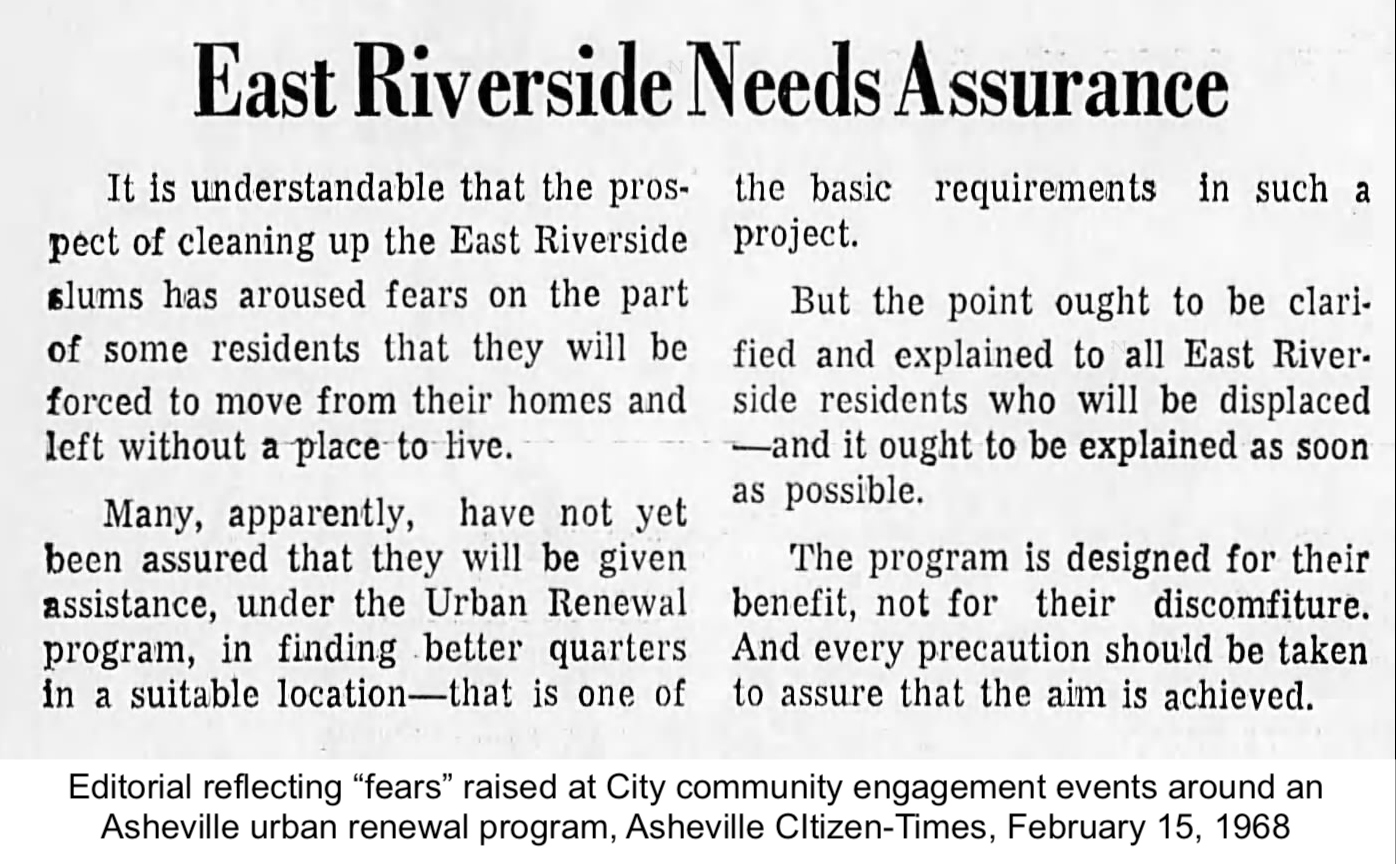
Going forward, The Block and East End/Valley Street should be present at every table where decisions are formed — with meaningful participation in shaping the project’s scope, design, and benefits.
Given the history outlined in this series, this is a modest request. For decades, decisions about this land were made without the voices of those most connected to it. Plans were proposed, partnerships explored, and visions advanced — but the communities displaced from this area were rarely asked what they wanted to see in its place.
This pattern must not repeat itself.
The question before the City is not simply what should be built on this land. It is how that decision will be made — and who will be empowered to shape it.
The history of this site is ultimately a story about power: who had it, who exercised it, and who did not. The opportunity now is to write a different ending — one in which the communities tied to this land are not an afterthought, but a primary partner.
The City owns this land today. With that ownership comes responsibility. The next chapter should begin not with a predetermined project, but with a commitment to shared decision-making and a seat at the table for those whose history is rooted here.
Click here to go back to the GAP Report on this issue.