
Areas of Agreement, Remaining Questions, and a Path Forward
Click here to go back to the GAP Report on this issue.
Executive Summary
For more than six months, the Government Accountability Project of Asheville (GAPavl) has encouraged Buncombe County to strengthen its approach to preventing displacement by developing a comprehensive anti-displacement analysis framework. Throughout that time, we have recognized that County leaders view displacement as an important challenge and have invested in affordable housing, disaster recovery, home repair, and other initiatives intended to help residents remain in their communities.
In late June, County Commission Chair Amanda Edwards and Commissioner Terri Wells responded to our recommendations by encouraging us to revisit the County’s 2043 Comprehensive Plan, the June 16 Growth Impact Strategies presentation by Planning Director Nathan Pennington, the Helene Recovery and Strategic Plans, and the Swannanoa Small Area Plan.
We appreciated that invitation and reviewed each of these carefully.
 Our review deepened our understanding of how Buncombe County approaches displacement. The County sees many of its planning, housing, recovery, and community development efforts as part of a broader, coordinated approach grounded in the Comprehensive Plan rather than as isolated programs or initiatives.
That deeper understanding also clarified where GAPavl’s perspective differs from the County’s. It is not about whether displacement matters or whether the County is taking meaningful action. Rather, it is about how the County’s existing planning and analytical tools should continue evolving to better support implementation decisions, evaluate displacement impacts, and learn from outcomes over time.
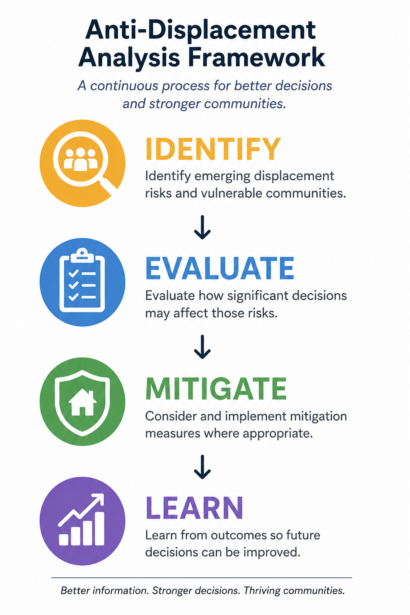
Throughout this report, we use the phrase anti-displacement analysis framework to describe a practical system that helps governments.
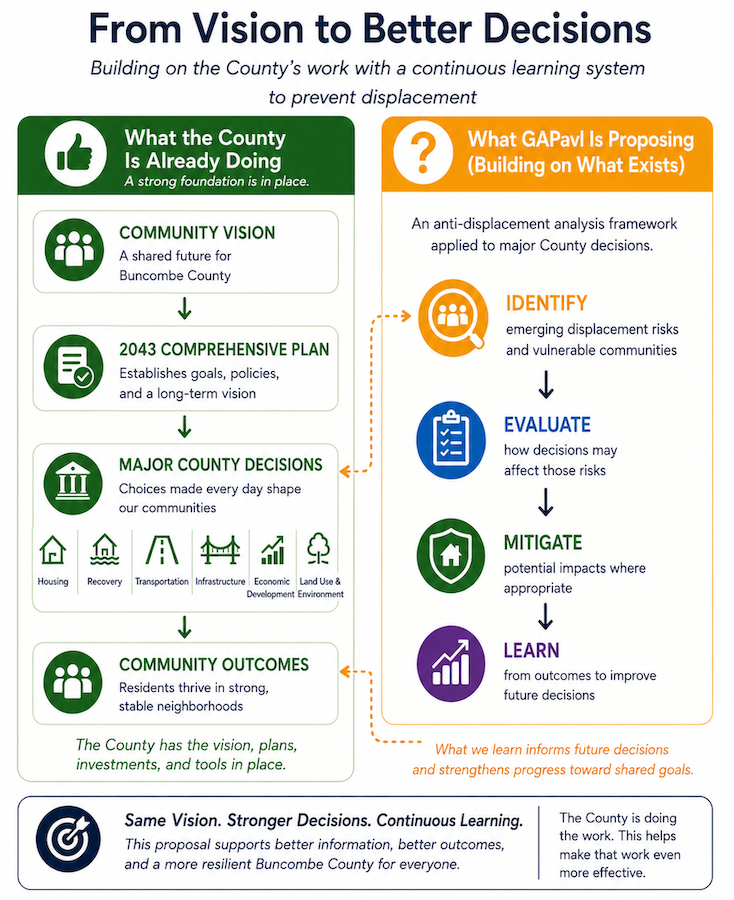
We are not recommending another housing program or another comprehensive plan. We are recommending a way to strengthen how the County implements the plans and programs it already has.
In our view, Buncombe County has built a strong foundation for preventing displacement. The opportunity now is to build on that foundation by strengthening how displacement considerations inform significant County decisions and continuous learning over time.
Our special report summarizes Buncombe County’s perspective in its own words, identifies the many areas where we found common ground, and explains why we believe this evolution represents the natural next step in implementing the County’s long-term vision.
1. Why Anti-Displacement Matters
Displacement is one of the defining challenges facing Buncombe County. Rising housing costs, redevelopment pressures, population growth, and the continuing impacts of Hurricane Helene have intensified concerns about whether longtime residents – particularly lower-income households and historically marginalized communities – will be able to remain in the neighborhoods they helped build.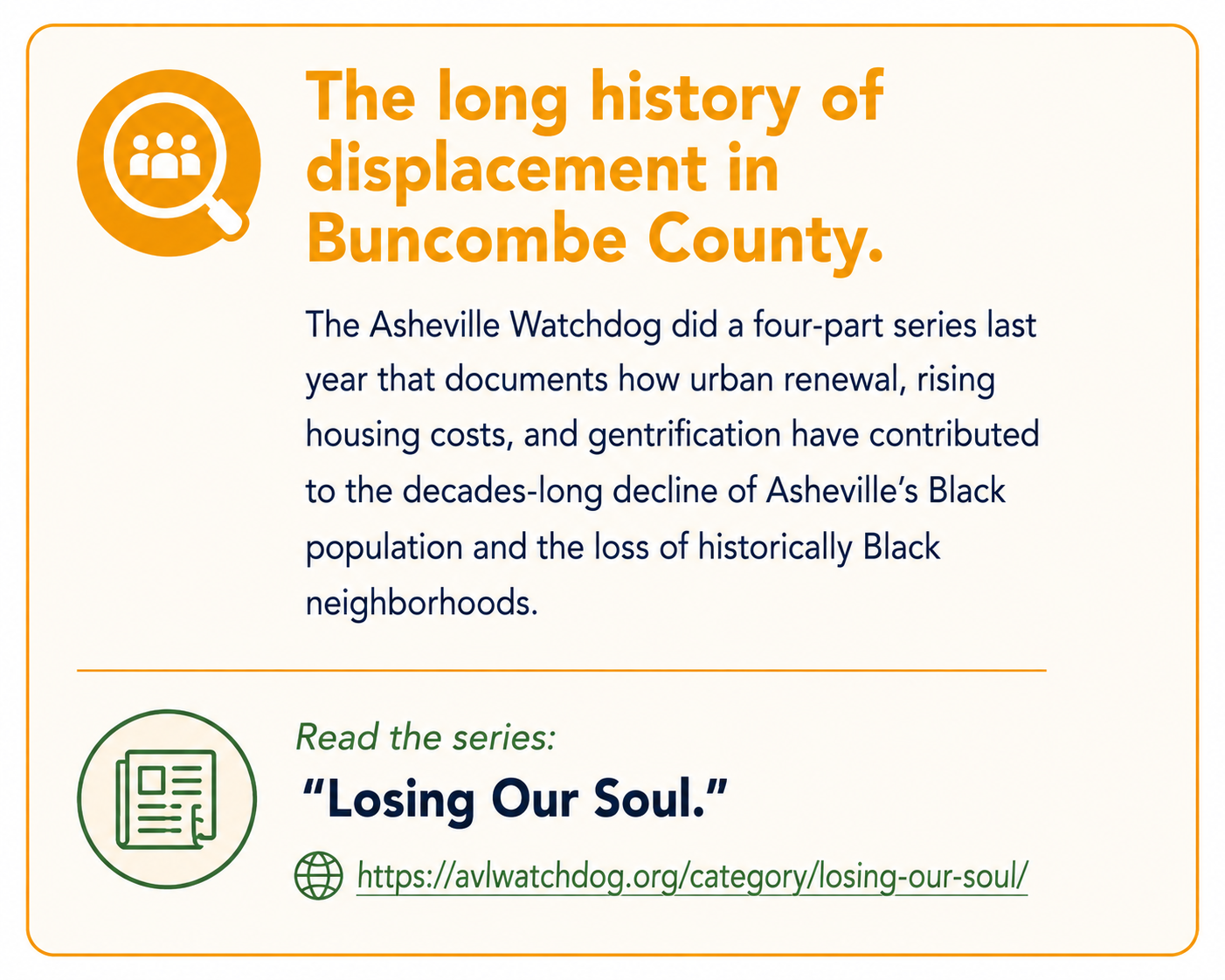
Buncombe County has responded through long-range planning, housing investments, disaster recovery, and community development initiatives. As those efforts move from planning to implementation, an important question naturally follows:
How can the County ensure that significant public decisions consistently advance its goal of preventing displacement?
The County’s own Comprehensive Plan acknowledges these challenges, identifying displacement and gentrification as threats to historically disadvantaged neighborhoods and calling for growth that protects existing residents. This report begins from that shared understanding and explores how implementation can further advance those goals. Building on the County’s recent response to GAPavl’s recommendations, it identifies areas of agreement, clarifies where our perspectives differ, and suggests an important opportunity for strengthening implementation over time.
2. Buncombe County’s Anti-Displacement Work
Buncombe County’s June 16 Growth Impact Strategies presentation offered a clear explanation of how County staff understand the relationship between planning, implementation, and displacement.
Planning Director Nathan Pennington explained that the County intentionally addresses complex issues such as displacement through comprehensive planning rather than through separate issue-specific policies. In his view, the Comprehensive Plan establishes the County’s long-term vision, while more detailed plans, programs, and investments implement that vision. Throughout the presentation, he returned to the idea that the County should “plan, protect, preserve, and produce” housing through a coordinated approach rather than treating anti-displacement as a stand-alone initiative.
The presentation also highlighted the County’s growing set of planning and analytical tools, including the Community Index Map, Future Land Use Map, and Impact Analysis Tool, together with a broad portfolio of housing, recovery, workforce, and neighborhood initiatives. A recurring theme was coordination. Rather than viewing planning, housing, transportation, economic development, infrastructure, and disaster recovery as separate efforts, staff emphasized that these initiatives increasingly work together under the broader vision established by the Comprehensive Plan.
Prompted by Chair Amanda Edwards and Commissioner Terri Wells, we also reviewed the Comprehensive Plan, the Helene Recovery and Strategic Plans, and the Swannanoa Small Area Plan. Taken together, these materials demonstrate a consistent philosophy. Buncombe County approaches displacement through coordinated planning, implementation, housing investments, disaster recovery, and a growing set of analytical tools rather than through a stand-alone anti-displacement policy.
3. Where We Agree
Reviewing these materials reinforced what we have believed from the beginning: Buncombe County has made preventing displacement an important part of its long-term vision.
We agree that preventing displacement requires coordinated action across housing, planning, economic development, transportation, disaster recovery, and other areas of government. We also agree that affordable housing, home repair, housing preservation, workforce development, and recovery investments all contribute to helping residents remain in their communities.
We were encouraged to learn more about the County’s existing planning and analytical tools, including the Community Index Map, Future Land Use Map, and Impact Analysis Tool, and to better understand how staff view these tools as supporting implementation of the Comprehensive Plan. We also appreciate the extensive community engagement that informed the Comprehensive Plan and subsequent planning efforts, giving residents a meaningful role in shaping the County’s long-term vision.
Taken together, these efforts represent a strong foundation. In our view, the next stage is not replacing that foundation, but continuing to build upon it.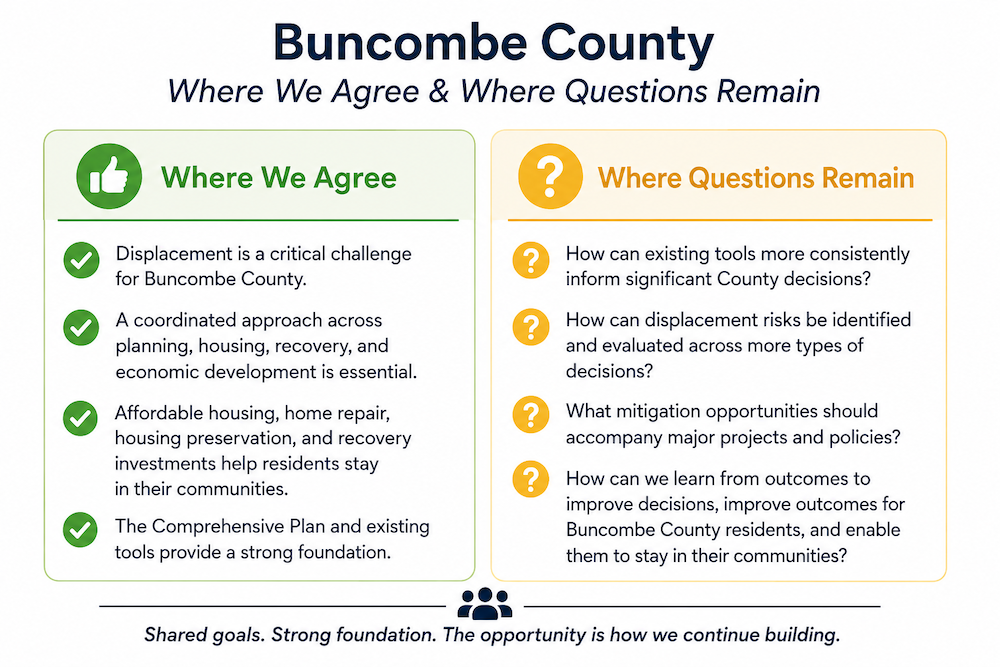
4. The Remaining Opportunity
What’s needed now is not to create another anti-displacement strategy. It is to strengthen how the County’s existing strategy informs everyday decision-making.
The Comprehensive Plan establishes the County’s vision, and the County has employed several planning and analytical tools to help implement that vision. Every year, however, County leaders make hundreds of significant decisions involving housing, disaster recovery, transportation, infrastructure, economic development, taxation, land use, and public investment.
We believe the County’s existing tools could continue evolving so they more consistently help decision-makers:
- Identify emerging displacement risks.
- Evaluate how significant public decisions may impact those at risk.
- Mitigate potential impacts where appropriate.
- Learn from outcomes so future decisions can be improved.
This is not a departure from the County’s current approach. It is, in our view, the natural next step in implementing it.
5. From Planning to Better Decisions
The distinction we are drawing is perhaps best illustrated by the County’s Helene recovery work.
The County has established ambitious recovery goals and carefully tracks implementation. It reports on homes repaired, households assisted, recovery dollars invested, infrastructure projects completed, commercial district revitalization, and many other measures of progress. These are important indicators, and they demonstrate a strong commitment to transparency and accountability.
At the same time, recovery requires hundreds of implementation decisions. County leaders must determine where to invest limited resources, which neighborhoods to prioritize, how to sequence projects, and how to balance competing community needs.
The County has already integrated displacement considerations into its long-range planning and many of its housing and recovery initiatives. Our recommendation is to build on that work by making displacement analysis a more consistent part of implementation. Rather than considering displacement primarily within individual plans and programs, we believe the County’s existing planning and analytical tools could evolve to help decision-makers routinely identify displacement risks, evaluate potential impacts, consider mitigation opportunities, and learn from outcomes across the full range of significant County decisions.
Alongside questions about project costs, timelines, and completion rates, decision-makers might also ask:
- Which neighborhoods are experiencing the greatest displacement pressures?
- How is this decision likely to increase or alleviate those pressures?
- Are there practical mitigation measures that should accompany this project?
- After implementation, what can we learn that will improve future decisions?
The same principle applies beyond housing and disaster recovery.
Buncombe County’s July 14 property-appraisal and budget decision provides a recent example. Commissioners had to choose between using older, less equitable property values and accepting an approximately $24.8 million budget gap. An anti-displacement analysis could have helped them compare who would be harmed under each option, how severely, and what protections might reduce that harm. The analysis might still have supported the decision they made, but it would have provided a more complete basis for choosing between two harmful options.
Earlier this year, when the County considered creating a Unified Fire District, GAPavl encouraged commissioners to consider whether the accompanying property tax increase – although relatively modest – might create additional displacement pressure for some Swannanoa homeowners already struggling in the aftermath of Hurricane Helene. Our point was not that the proposal should necessarily be rejected. Rather, we suggested that understanding potential displacement impacts could help inform the decision and identify opportunities to reduce unintended consequences.
For example, the County might have considered phasing in the tax increase, expanding outreach about existing property tax relief programs, prioritizing additional housing stabilization investments in the most affected neighborhoods, or monitoring tax delinquency, foreclosure, and property transfer trends to determine whether the policy was having unintended effects.
In both examples, the question is not whether the County’s Comprehensive Plan expresses the right goals. The question is whether the County can consistently and systematically use its existing tools – both before and after decisions are finalized – to ensure that residents remain in their homes.
6. The Next Step
Our recommendation is not another comprehensive plan, another housing initiative, or another stand-alone anti-displacement policy.
Instead, we encourage Buncombe County to continue building upon the planning and analytical tools it already employs by considering how they might evolve into a more standardized and connected decision-making and evaluating system.
Such a system could:
- Employ the existing Community Index Map, Future Land Use Map, Impact Analysis Tool, and other planning resources
- Apply displacement analysis consistently across policy areas,as a matter of course in decision-making
- Identify practical mitigation measures before projects and policies are finalized, where appropriate
- Compare the distribution of benefits and harms across competing options, including who is likely to be affected and by how much.
- Scale the depth and timing of the analysis to the decision, from a rapid assessment during an urgent fiscal choice to a more detailed review of a major infrastructure or development proposal.
- Track displacement indicators alongside existing implementation metrics
- Use what is learned to improve future decisions
- Continue sharing information with the community and incorporating public feedback as implementation moves forward
The framework need not require a new department, an elaborate review process, or a major investment. Its purpose would be to organize existing data, expertise, and decision-making practices so that displacement risks can be examined at the depth and speed each decision requires.
We see this as a natural extension of the County’s current approach rather than a departure from it. The Comprehensive Plan establishes a shared vision of helping residents remain in their homes. The next opportunity is to ensure that the County’s implementation strategies continue evolving so they consistently prioritize antidisplacement across departments and over time.
7. Continuing the Conversation
We appreciate Chair Amanda Edwards and Commissioner Terri Wells for responding directly to our recommendations and encouraging us to take a closer look at the County’s work.
That invitation strengthened our understanding of how Buncombe County approaches displacement and highlighted substantial areas of agreement. It also helped clarify the remaining opportunity we see.
Buncombe County has built a strong foundation through its Comprehensive Plan, housing initiatives, recovery work, community engagement, and existing planning tools.
Our recommendation is simply to build on that foundation.
A comprehensive plan tells us where we hope to go. The next step is ensuring that the County has the information it needs to determine whether each significant decision is moving toward – or away from – that vision, and to adjust course when evidence points to a better path.
We offer this report in the spirit of collaboration and continuous learning. We hope it contributes to an ongoing dialogue about how Buncombe County can continue strengthening its approach to preventing displacement while building upon the thoughtful work that is already underway.
Click here to go back to the GAP Report on this issue.