
REPORT BACK STATUS
Resolved (Still Questionable)
Report Back
On July 14, Buncombe County Commissioners unanimously chose to use the 2021 Schedule of Values and set the County property-tax rate at 61.54 cents per $100 of assessed value. This preserved the FY27 budget rather than reducing County revenue by approximately $24.8 million. Commissioners cited the need to protect education, public safety, human services, and other essential County functions.
During the meeting, staff demonstrated that the decision would affect homeowners differently depending on how much their values increased during the 2026 reappraisal. Commissioners also acknowledged that delaying the revaluation would make the property-tax system less fair. Following the County’s action, Asheville amended its own tax rate because it must use the property values established by the County.
It’s important to note that while County staff presented some analysis of how the shift in property taxes would affect homeowners, it did not publicly present any options for budget reductions or a comparable, resident-level analysis of what that impact might be. We examine what this means – and why it strengthens the case for an anti-displacement analysis framework – in our new report.
Total GAP Supporter Actions Taken: 16
Recipients and Responses:
Buncombe County Commission
- County Commission Chair Amanda Edwards: No response
- County Commissioner Al Whitesides: No response
- County Commissioner Drew Ball: No response
- County Commissioner Jennifer Horton: No response
- County Commissioner Martin Moore: No response
- County Commissioner Parker Sloane: No response
- County Commissioner Terri Wells: No response
QUESTIONABLE
Summary: Buncombe County Commissioners are required to make an extraordinarily difficult decision, one largely created by circumstances beyond their control. They must choose between preserving County services by continuing to use older property values, or implementing new property values and reducing County spending by approximately $24.75 million. Neither option avoids harm. The challenge is that the consequences of these two choices are not equally understood. The inequities associated with the older property values have been studied and quantified: Independent analysis found that the old property appraisals overcharged lower-income homeowners by approximately $1.5 million annually while underassessing higher-value properties by $4 million. In contrast, the impacts of a $24.75 million budget reduction remain largely undefined because County staff have not publicly identified what would be cut. Without a clearer understanding of the consequences of both options, residents and elected leaders alike are being asked to make an extraordinarily difficult decision with only part of the picture.
Last month, the North Carolina General Assembly enacted legislation placing a temporary moratorium on the use of newly completed property reappraisals in counties where appeals remained unresolved. The political pressure that led to this legislation was driven largely by concerns about substantial tax increases on higher-value properties that had experienced above-average appreciation. Because Buncombe County’s reappraisal appeals had not yet been finalized, the legislation effectively prevents the County from implementing its new values without significant budget cuts.
As a result, Buncombe County now faces two options:
Option 1: Continue using the older property values and return the County tax rate to approximately 61.54 cents per $100 of assessed value. County staff have recommended this approach because it would preserve the County’s adopted Fiscal Year 2027 budget and avoid approximately $24.75 million in budget reductions.
Option 2: Implement the new reappraisal values and adopt the revenue-neutral tax rate of approximately 40 cents per $100 of assessed value. This would require the County to close a $24.5 million deficit that was part of their approved 2027 budget. The County would need to revise that budget in order to eliminate that deficit.
County staff have not publicly identified what programs, services, or investments would be reduced under Option 2.
An independent analysis conducted by Urban3 found that Buncombe County’s previous assessment system substantially undervalued many higher-value properties while overvaluing many lower-value homes – the definition of a regressive tax. According to the analysis, the County was collecting approximately $4 million less in property taxes from higher-income homeowners than it otherwise would have because those properties were underassessed, while lower-income homeowners were paying approximately $1.5 million more in taxes than they should have because their homes were overassessed. Lower-income homeowners in Buncombe County are disproportionately people of color.
The County’s agenda materials include an example showing the impact of the legislation on a home valued at $350,000 in 2021. Because that example property’s appreciation is close to the countywide average, the estimated tax differences between the two options are relatively modest. The materials do not provide comparable examples of properties that experienced substantially above- or below-average appreciation, including lower-valued homes that may have been historically overassessed or higher-valued homes that may have been historically underassessed.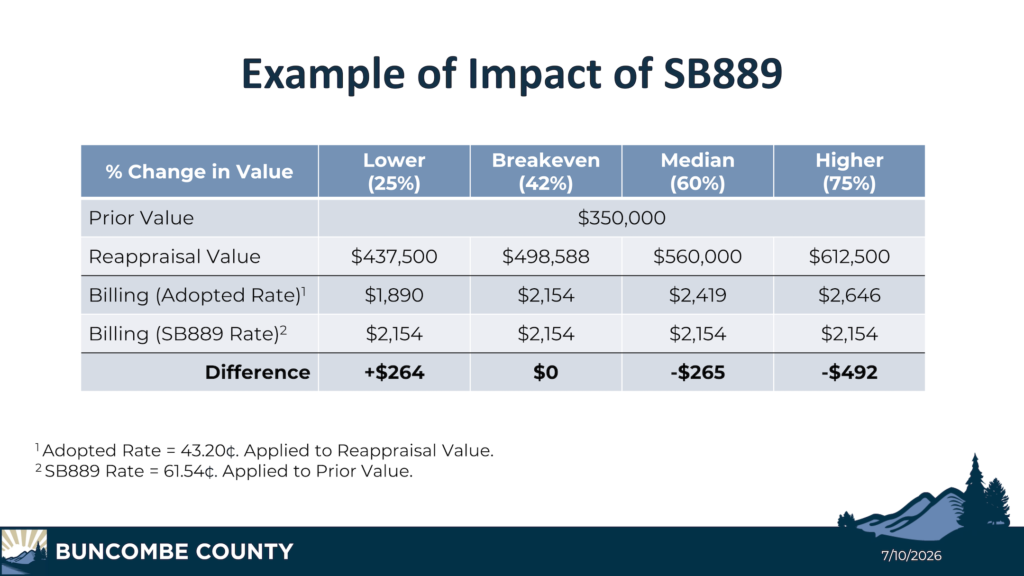
Our Assessment: This is not a choice between a good option and a bad one. It is a choice between two competing forms of harm.
Under one scenario, the County preserves important public services but does so using property values that disproportionately tax owners of lower- and moderately-valued homes. Under the other, the County implements a more equitable tax structure but may need to reduce spending in ways that could affect services many residents depend upon.
In order to choose, we must understand the consequences of each path equally well, and we cannot without transparency.
The consequences of continuing to use the older property values have been studied and, at least to some degree, quantified. By contrast, the consequences of a $24.75 million budget reduction remain largely unknown because the County has not publicly identified how those reductions would be achieved. Perhaps such reductions would disproportionately affect vulnerable residents. But perhaps there are ways to absorb these reductions while minimizing harm. At this point, we simply do not know.
This incomplete picture extends beyond the potential budget reductions. As described above, the County’s presentation includes an example showing the impact of the legislation on a home whose appreciation was close to the countywide average and therefore experiences relatively modest differences under either option. Residents have not been shown comparable examples illustrating how these choices affect properties whose values diverged significantly from the average – including lower-valued homes that may have been historically overassessed or higher-valued properties that may have benefited from undervaluation. As a result, the public has been given only a partial view of the tax equity implications of this decision as well.
When difficult decisions involve competing harms, transparency becomes especially important. Residents and elected leaders should be able to compare the likely consequences of both options before determining which path causes the least harm.
We do not raise these concerns to suggest that County leaders should have anticipated this extraordinary situation. Nor are we advocating for a particular outcome. Rather, we believe the public deserves a fuller understanding of the implications of both options before this decision is made.
Moments like this further strengthen the case for stronger analytical tools that help leaders understand who is likely to be affected by difficult decisions and by how much. Building the capacity to evaluate and compare potential harms before the next crisis arises may be one of the most important investments our community can make.
Things to do: Use our template to contact the County Commissioners to thank them for their service during this difficult moment and encourage them to ask their staff for a more complete public accounting of the consequences of both options before making this important decision.