
REPORT BACK STATUS
Unresolved
Report Back
Updated 7/20/26: Buncombe County’s July 14 property-tax and budget decision provides a real-world example of why an anti-displacement analysis framework is needed. State legislation forced the County to choose between using older, less equitable property values and reducing County revenue by approximately $24.8 million. County leaders understood that either option could harm residents, but they did not have a systematic framework for comparing the displacement implications of those harms. Read our new case study and ask Commissioners to respond to this proposal here.
Updated 7/6/26: We shared our special report with Buncombe County leaders on Monday, June 29, and are still awaiting a reply. We’ll continue to keep you updated.
QUESTIONABLE
Executive Summary
For more than six months, the Government Accountability Project of Asheville (GAPavl) has encouraged Buncombe County to strengthen its approach to preventing displacement by developing a comprehensive anti-displacement analysis framework. Throughout that time, we have recognized that County leaders view displacement as an important challenge and have invested in affordable housing, disaster recovery, home repair, and other initiatives intended to help residents remain in their communities.
 In late June, County Commission Chair Amanda Edwards and Commissioner Terri Wells responded to our recommendations by encouraging us to revisit the County’s 2043 Comprehensive Plan, the June 16 Growth Impact Strategies presentation by Planning Director Nathan Pennington, the Helene Recovery and Strategic Plans, and the Swannanoa Small Area Plan.
We appreciated that invitation and reviewed each of these carefully.
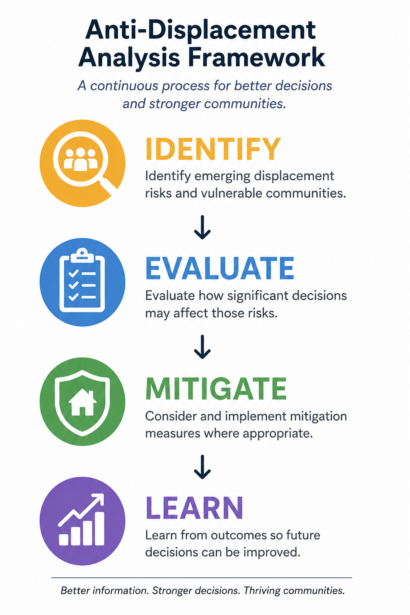 Our review deepened our understanding of how Buncombe County approaches displacement. The County sees many of its planning, housing, recovery, and community development efforts as part of a broader, coordinated approach grounded in the Comprehensive Plan rather than as isolated programs or initiatives.
That deeper understanding also clarified where GAPavl’s perspective differs from the County’s. It is not about whether displacement matters or whether the County is taking meaningful action. Rather, it is about how the County’s existing planning and analytical tools should continue evolving to better support implementation decisions, evaluate displacement impacts, and learn from outcomes over time.
Throughout this report, we use the phrase anti-displacement analysis framework to describe a practical system that helps governments.
We are not recommending another housing program or another comprehensive plan. We are recommending a way to strengthen how the County implements the plans and programs it already has.
In our view, Buncombe County has built a strong foundation for preventing displacement. The opportunity now is to build on that foundation by strengthening how displacement considerations inform significant County decisions and continuous learning over time.
Our special report summarizes Buncombe County’s perspective in its own words, identifies the many areas where we found common ground, and explains why we believe this evolution represents the natural next step in implementing the County’s long-term vision.
(You can read our older reports on this issue here.)
Things to do: This week, we are inviting County leaders to respond directly to this report, so we are not suggesting any action as we await that response. To read the full special report, click here.