
Summary of the Report
Updated Item: Community got their seat at the table as Asheville explores possibility of Performing Arts Center on The Block
City Council voted unanimously on Tuesday, March 24, to place a two-year land hold on the “Parkside” parcels to explore the building of a downtown performing arts center in Asheville. Importantly, the final approved version of the resolution stipulates that the City will “create and utilize, as part of this process, meaningful and robust partnerships [emphasis added] with the surrounding communities, including but not limited to the Block and East End.” This status of “partner” is of great significance to these communities–earlier drafts had merely offered “engagement”–so this commitment is a win.
It’s also important to acknowledge that this project–a proposed performing arts center on The Block–is still a highly problematic idea, and one that the vast majority of folks in these communities don’t want to see happen. Almost everyone we’ve talked to would have preferred to see the “land hold” rejected or at least postponed until there could be deeper community conversation. Given that, you might be wondering why we didn’t push for a City Council “no” vote. The simple answer is that allies inside government were confident that this land hold had enough solid votes to pass; we were nowhere close to amassing the clout to stop it. A call to action that asked City Council to vote it down might have yielded a few “nay” protest votes from Council Members, but the project was going to move forward.
It’s also important to note that this vote is just one step along the road to this project becoming a reality. The land hold is not yet a commitment by the City to build this facility. Local communities and advocacy groups like GAPavl are fully prepared to push back as the project progresses, if it continues to look like it will do far more harm than good.
Given the political realities and the nonbinding status of the land hold, leaders in the affected communities concluded that their best option was to engage from within the process as it moved forward—advocating for their neighbors’ needs—rather than remain on the outside, as they had until now, with limited access to development processes and little ability to influence or halt them. So they landed on a compromise position: full “partnership” status in the next phase of this process, just like the other named partners like Arts AVL and the Asheville Symphony. That’s what we helped them advocate for, and that’s what we were able to achieve.
As of Tuesday morning, it looked like they weren’t going to get this important concession. The original draft of the resolution called for “engagement” of these neighborhoods, a far cry from the status they were seeking. These communities have been offered various forms of public or community “engagement” in past City initiatives–including during/amid urban renewal–which typically meant they were asked to give input (that was ignored) or merely kept informed of changes that were coming (over which they had no real influence). What the community was asking for in this case was something more substantive; they wanted partnership and power, a true “seat at the table” for the forthcoming exploration of this performing arts center project.
And that’s what they were able to secure in the end, due in no small part to the flurry of activity that GAPavl supporters generated on their behalf. There is still a lot of work to be done to ensure that these communities and their history are adequately considered, and that the land that was taken from them is developed in a way that uplifts them. But we want to take a moment to express our appreciation for what we were able to accomplish together on Tuesday–not a final victory, but a meaningful victory nonetheless. Standing together, the struggle goes on!
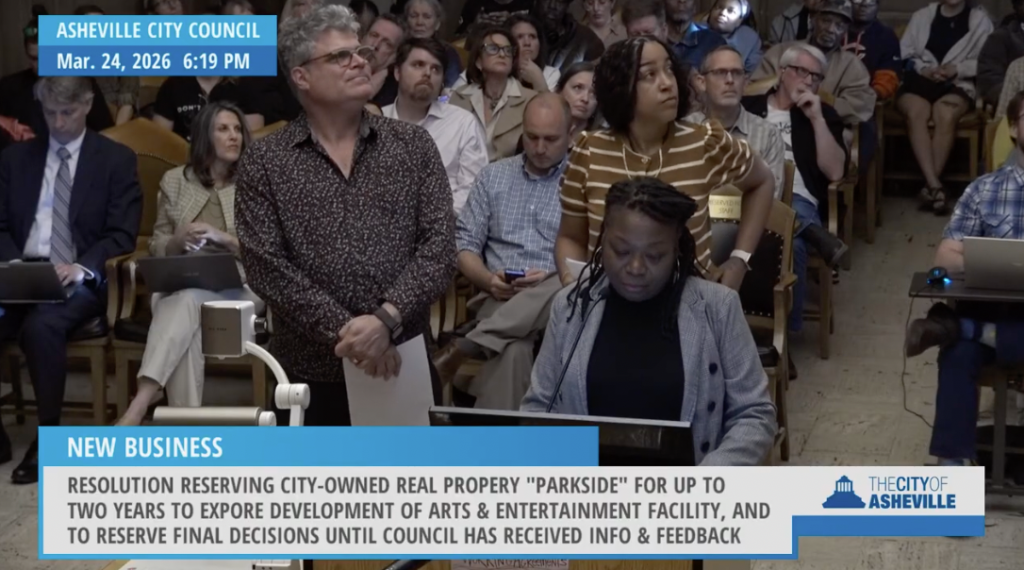
GAP Team members Tiffany DeBellott, Nina Ireland, and David Greenson making a public comment at Tuesday’s CIty Council Meeting. You can watch our presentation at this link if you go to the 1:18:50 minute mark.
Coming Soon: Updates on the need for an anti-displacement policy for both Asheville and Buncombe County
City staff recently presented promising plans for developing an anti-displacement policy, and Council appeared receptive. At the County level, however, there was no discussion of displacement even as major decisions moved forward. We’ll dive deeper into this in coming weeks — but today’s focus is the time-sensitive performing arts center vote.
Templates and Links to More Information
Take action with us:
Here are all active email templates:
- Major County Decisions Are Being Made Without an Anti-Displacement Policy
- Emailing the Buncombe County Commission and the Asheville City Council about the need for an overarching anti-displacement policy.
We prepared a three-part Special Report on the history of the proposed performing arts center called “Before Parkside: An Active Eagle Street Community.”
- Click here to read our introduction
- Click here for Part 1
- Click here for Part 2
- Click here for Part 3
Click here to read our full proposed anti-displacement policy proposal.